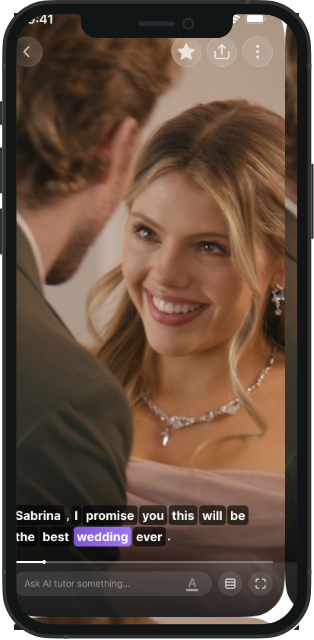
Drama-based language learning: does it work (science + practice + routine)
Does learning a language through dramas work? Learn the benefits, limits, and a simple routine to make drama-based learning effective.


Drama-based language learning can work.
It is not magic, and it is not the same as “watching Netflix with subtitles.”
It works when you turn a scene into repeatable, speakable phrases.
This guide explains why it works, where people get stuck, and a simple routine you can follow in 10 minutes a day.
Quick answer
Yes, it works best when you do three things:
- Repeat the same short scene (instead of bingeing new episodes).
- Save 1–3 lines you would actually say.
- Practice variants (soft, neutral, strong) and say them out loud.
If you only watch once and move on, you will improve your comfort with the language, but progress will be slow and uneven.
Why dramas help (what’s happening in your brain)
Textbooks teach correct English. Dramas teach usable English.
Here is what stories give you:
1) Context that makes meaning stick
When a character says “Fine.” you can hear whether it means “OK” or “I’m upset.”
That context is hard to learn from isolated sentences.
2) Emotion that improves memory
Emotion acts like a highlighter.
If you feel tension, romance, embarrassment, or relief in a scene, your brain stores the language with stronger signals.
3) Timing, rhythm, and interruption
Real English is not clean.
People overlap, pause, change direction, and soften statements mid-sentence.
Dramas expose you to that rhythm.
4) Social meaning (tone + power)
A phrase can be polite in one relationship and insulting in another.
Stories let you see the power dynamic, which is crucial for sounding natural.
The 3 reasons it doesn’t work (and fixes)
Most people fail for predictable reasons.
Failure mode 1: Passive bingeing
You watch 30 minutes, learn 0 phrases, and feel productive.
Fix: switch from “episodes” to moments.
Rewatch 30–90 seconds and learn it deeply.
Failure mode 2: No output
You understand more, but you cannot respond.
Fix: after each scene, speak one reply.
Even 30 seconds of speaking changes your learning curve.
Failure mode 3: Too hard too soon
If every sentence feels like noise, you stop.
Fix: lower difficulty:
- choose simpler dialogue
- use subtitles strategically
- slow playback for the first pass
You want “challenging but followable,” not chaos.
A 10-minute routine that makes it work
If you do nothing else, do this.
Step 1: Watch 2–4 minutes (first pass)
Watch a short segment once for the story. Do not pause.
Step 2: Pick 1 line you genuinely want to use
Choose a line that matches a real situation:
- pushing back at work
- apologizing
- flirting
- setting a boundary
Step 3: Write 2 variants
Make the line usable in real life by creating:
- softer version (less risky)
- stronger version (clear boundary)
Step 4: Say each version once out loud.
Do not worry about accent. You are training confidence and timing.
Step 5: Rewatch the same moment tomorrow
Your goal is familiarity.
When the line becomes predictable, your brain stops panicking and starts learning.
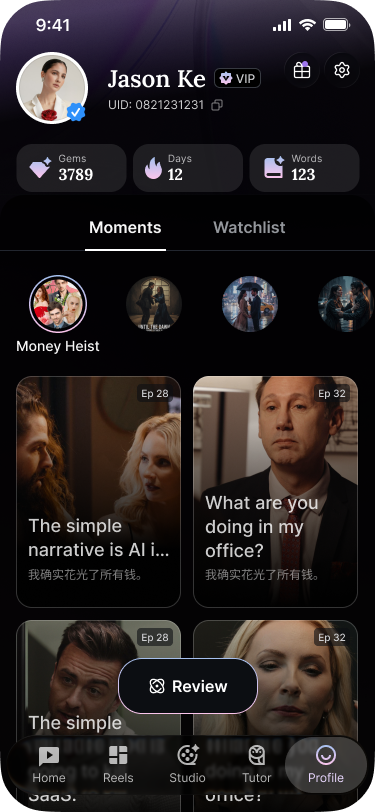
You can review the moments you captured in the profile tab in ReelFluent.
What to watch (level + genre + subtitles)
Choose the right level
A2–B2 learners usually benefit the most.
If you are A1, use very short clips and heavy support.
If you are C1, focus on tone and social meaning.
Use subtitles like training wheels
- Start with subtitles if needed.
- On the second pass, hide them for 10–20 seconds.
- Bring them back when you lose the thread.
Over time, reduce dependence.
Pick genres that match your goals
- workplace/power dynamics → negotiation, boundaries, clarity
- romance → emotional expression and softening
- family drama → disappointment, repair, honesty
How ReelFluent fits
ReelFluent is built around a simple loop:
- Moment: you catch a line in a scene.
- Meaning: you understand the subtext and tone.
- Practice: you learn soft/medium/strong variants you can actually use.
Instead of collecting quotes, you build a habit of turning entertainment into language.
FAQs
Is drama-based learning better than classes?
It can be better for consistency and natural phrasing. Classes are better for structured feedback.
Many learners improve fastest by combining both.
How long until I see results?
If you practice daily for 10 minutes, many people notice improved listening comfort within 2–4 weeks.
Speaking confidence takes longer, but it accelerates once you start producing short replies.
Do I need to understand every word?
No. Aim to understand the situation and the key line you are learning.
Try ReelFluent
If you want a fun-first routine that still builds real phrases, try ReelFluent and practice one short scene a day.