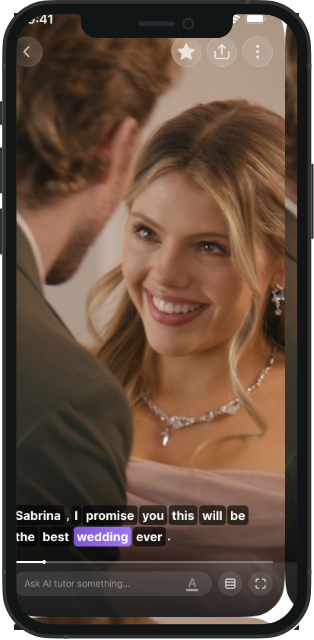
Comprehensible input explained: how microdramas make language learning easier
Learn what comprehensible input is, why it works, and how to use short microdramas to build listening and vocabulary with less overwhelm.


If you have ever felt like language learning is “work” but watching shows is “fun”, comprehensible input is the bridge between the two.
Comprehensible input is simply language you can mostly understand, with just a little bit that stretches you. When the message makes sense, your brain can start absorbing vocabulary, grammar, and natural phrasing without forcing yourself to memorize rules.
The twist is that you do not need hour-long TV episodes for this. Short, emotional microdramas can be one of the easiest ways to get repeatable, level-matched input that still feels like entertainment.
What is comprehensible input?
Comprehensible input means listening or reading to language that you understand most of. You do not need to understand every word.
A helpful rule of thumb is:
- If you understand roughly 80–95% of what is happening, the input is usually “comprehensible enough” to learn from.
- If you understand less than that, you will spend all your energy guessing and you will learn slower.
- If you understand almost everything with zero effort, you can still learn, but progress may feel slower unless you add a small challenge.
Comprehensible input is not:
- “random immersion” where you are lost most of the time
- memorizing word lists without context
- treating every video like a test where you must catch every word
Instead, it is about understanding the story and letting the language patterns repeat until they become familiar.
Why comprehensible input works (in real life)
When input is understandable, three good things happen naturally.
- You learn meaning from context.
- You connect phrases to a situation, facial expressions, and consequences. That is closer to how native speakers learn and use language.
- You get repetition without boredom.
- In real conversations, the same intentions show up again and again: clarifying, refusing, apologizing, flirting, setting boundaries. Stories recycle these intentions, which means you get built-in review.
- Your phrasing becomes more automatic.
- Comprehensible input helps you stop translating word-by-word. You begin to recognize chunks like “Wait, what do you mean?” or “That is not what I said,” and your brain retrieves them faster.
The input hypothesis (i+1) in one minute
You will often hear comprehensible input explained with i+1.
- i = what you already understand comfortably
- +1 = one small new step
In practice, i+1 looks like this:
- You understand the scene and the intention.
- You notice one new phrase, one new structure, or one pronunciation detail.
- You repeat enough times that the “+1” becomes part of your “i”.
A concrete example:
- You already know “I do not know.”
- In a scene, you hear: “I have no idea.”
- That is your +1. You learn it because the situation makes it obvious and the line repeats across different scenes.
Comprehensible input examples (quick and practical)
Here are a few real-life checks you can use.
- Example 1: You understand the scene but miss one key phrase.
- You still know who is angry, who is apologizing, and what the conflict is. That is learnable.
- Example 2: You catch the intention even if you miss a few words.
- You can tell the speaker is rejecting an offer, setting a boundary, or trying to repair trust.
- Example 3: You can predict the next line.
- When you start anticipating a response like “Are you serious?” or “Let me explain,” your brain is building patterns.
If none of these are true and you are confused the entire time, the input is probably not at the right level yet.
How to find the right level (so it feels easy, not exhausting)
Choosing the right level is the difference between “this is fun” and “this is draining.”
Signs it is too hard
- You cannot follow the main story without pausing.
- You need native-language subtitles the whole time.
- You feel tense because you are trying to decode every sentence.
Signs it is the right level
- You understand the overall situation.
- You can pick up repeated words and phrases.
- You can learn a few new things per scene without getting overwhelmed.
Signs it is too easy
- You never learn anything new.
- You do not feel any stretch.
If it is too easy, the fix is not “choose harder content” immediately. Instead, keep the content comfortable and add a controlled +1:
- turn subtitles off for the final replay
- focus on one new chunk to shadow
- listen for a specific pronunciation point
How to use microdramas for comprehensible input (the ReelFluent method)
Microdramas work because they are short enough to repeat and emotional enough to be memorable.
Here is a simple, repeatable routine you can do in 10 minutes.
- Pick a short scene with clear context.
- Choose something where the situation is obvious quickly: an argument, a confession, a misunderstanding, a power move at work.
- First watch: watch for meaning (no pausing).
- Do not test yourself. Just follow the story.
- Second watch: add target-language subtitles if needed.
- Try to connect sounds to words. Do not translate every line.
- Loop 3–5 times. Each loop has one focus.Choose one “+1” target:
- a useful phrase
- a sentence pattern
- a pronunciation feature
- Shadow 1–2 lines.
- Copy the rhythm and intonation. This makes input “stick” faster.
- Do a 30-second mini output or use ReelFlunet AI Dubbing.
- Say the same line as if it were your situation.
- For example, if the scene line is a boundary, reuse the pattern with your own words.
This is the core idea behind ReelFluent: short, dramatic scenes that make repetition feel natural, not boring.
Subtitles strategy (when to use them and when not to)
Subtitles can help, but only if you use them intentionally.
- Start with target-language subtitles when you need help connecting sounds to words.
- Avoid switching to native-language subtitles too early.
- Native-language subtitles can become a crutch that reduces listening growth.
- Do a final pass with subtitles off.
- This confirms your listening progress and shows you what you truly understand.
A simple pattern that works for many learners:
- Pass 1: subtitles off
- Pass 2–3: subtitles on (target language)
- Pass 4: subtitles off
Common mistakes (and how to fix them)
Mistake 1: Choosing content that is too difficult
- Fix: choose easier scenes, shorter scenes, or clearer context.
Mistake 2: Treating input like a test
- Fix: focus on the story first. Learning happens because you understand.
Mistake 3: Not repeating enough
- Fix: loop the same scene several times. Repetition is the point.
Mistake 4: Trying to learn everything in one session
- Fix: pick one +1 target and let everything else be background.
How much comprehensible input do you need?
It is normal to want a clear number, but the most helpful mindset is:
- Consistency beats intensity.
If you can do 10 minutes a day, you are building a habit that compounds.
A beginner-friendly weekly plan:
- 5–6 days per week: one microdrama loop session (10 minutes)
- 1 day: rewatch favorites for confidence (no pressure)
Progress often feels slow at first because your brain is building recognition. Then, after enough repetitions, you suddenly understand more with less effort.